Scots, in the lowlands, almost became a different language, but ended up just being a different accent of English. Scotland remained, nevertheless, an entirely independent country, despite the massive cultural similarities to England.
Scottish language has been preserved, despite the influences. Stanley Robertson in Aberdeen knows lots of stories in Scottish, such as Jack and the Devil's Castle. They are told orally, and foment the preservation of the language. Something to note is how the Scottish aristocracy left and the Southern influence grew immensely, which are factors that negatively impacted the Scots.
The Scots remained as a whole, even with these events and causes, that could've caused the disintegration of such. They saved themselves and at least preserved their accent, and their culture and national pride.
One thing I found interesting and somewhat funny was how when the New Testament of the Bible was released for the Scots, only the devil spoke London English. They were literally demonizing the people of London, as a whole.
In the 1750's, Scots migrated to Pennsylvania and added new sounds to American English. The cultural exchange was very rich, as the documentary narrates.
"In 1760, Benjamin Franklin, who was right about most things, estimated that Pennsylvania was one-third English, one-third German, and one-third Scots-Irish."(1) The influence was more than obvious, and the language was being fed by multiple peoples and cultures. The Amish farmers also are there and live the way they do, because of Germans. They exchanged with the Scots-Irishmen, and fed the culture even more, to create a more diverse environment both for language and culture.
 One thing particularly interesting I learned, is that hillbillies' originated from the Scots-Irish. I've always been intrigued with how they talk and where they got the accent from, and it makes a lot of sense, now. "Well, Ray and I has been growed up in the mountains. Ray was raised right here, and I was raised not too far from over across the hill there."(1) Their word order is particularly interesting in the sense of their conjugation of verbs and tenses, not to mention wrong. Nevertheless, I find them hilarious.
 The hillbilly stories told by Ray are equivalent to the stories in Aberdeen, with Stanley Robertson. Jack and the Beanstalk is fifteen times more interesting in that accent, really. "Whickety wack, he said, devils come down in this sack"(1) sounds like an entirely different story in hilbilly.
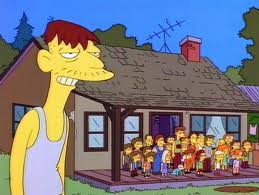
 I couldn't help but picture Cletus, the hillbilly from The Simpsons, every time the hillbillies spoke, or sat in the porch of their house. I really thought Cletus was a very exaggerated and off version of actual hillbillies, but turns out he isn't. With an exception of Cletus' forty-four inbred kids, hillbillies act pretty much the same.
 Frankly, the episode started off incredibly boring and dull, but the hillbilly talk, country music, square dancing, and southern accents made it all better.
1. MacNeil, Robert, Robert McCrum, and William Cran. "The Guid Scots Tongue."The Story of English. Dir. William Cran. PBS. N.d. Television.

No comments:
Post a Comment